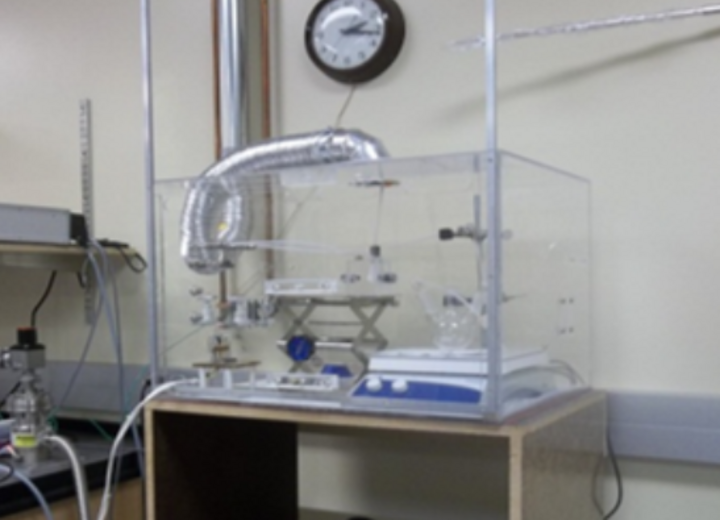
As stated, a chemical fume hood must be used when it is necessary to protect against chemical exposures. When used for this purpose, the hood must be manufactured. Lab-made devices are not acceptable when their purpose is to protect people against hazardous chemical exposures unless approved by EHS working in conjunction with Facilities to ensure necessary airflow for intended use. This is an example of a lab-made fume hood located in a laboratory and constructed with plexiglass. They even made a moveable sash of sorts. Notice the dryer vent that is used to connect the box to a ventilation drop attached to the wall. After asking a few questions it was learned that they constructed this fume hood because the reaction that was being carried out inside created toxic, hydrogen sulfide gas!!! After a thorough analysis, EHS did allow the researcher to continue to use this device based on a few factors:
- It was a very short duration project;
- They agreed to limit the amount of reactants to a quantity that was incapable of creating a level of hydrogen sulfide gas in excess of occupational exposure limits;
- They agreed to modify their process to reduce the possibility that contaminated glassware and such could liberate hydrogen sulfide gas after being removed from the enclosure.
When you see a lab-made ventilated enclosure, you need to ask questions:
- Find out what is being used inside,
- Does the material pose a toxicity concern,
- What quantity is being used,
What are they trying to accomplish with the lab-made device.
Be sure to document the situation by taking a picture of the enclosure, and follow up with a Senior Specialist.