Overview
There is evidence of food/drink consumption in the areas where chemicals are used or stored.
Cite this when there is evidence of eating/drinking/utensils, etc. Auditors do not have to actually observe someone eating/drinking/washing dishes; the appearance of eating in the lab is enough “evidence” to cite this (e.g., wrappers in the trash, cups in the sink, eating utensils/dishes in lab dishwasher, etc.).
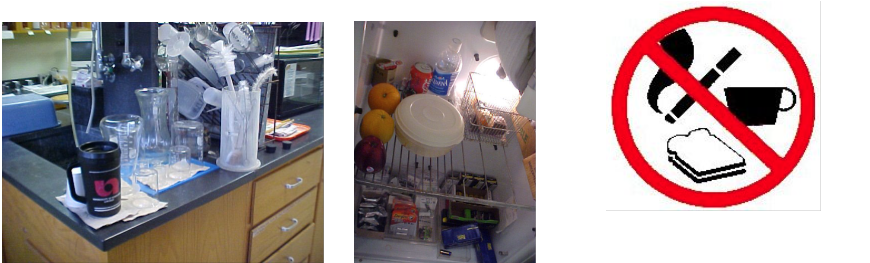
Sometimes, there will be laboratory tests/research conducted on foodstuffs. In those cases, the materials should be labeled as "Not for Human Consumption" or something equivalent.
Use of empty food containers for storage of chemicals is not recommended.
Citations and Related Resources
Citations
1910.141(g)(2) Eating and drinking areas. No employee shall be allowed to consume food or beverages in a toilet room nor in any area exposed to a toxic material.
(g)(4) 1910.141(g)(4) Sanitary storage. No food or beverages shall be stored in toilet rooms or in an area exposed to a toxic material.
29 CFR 1910.1450(e)(3)(ii) The CHP shall include control measure to reduce employee exposure to hazardous chemicals including….hygiene practices…
Prudent Practices 6.C.2.3: Eating, drinking, smoking, gum chewing, applying cosmetics, and taking medication in laboratories where hazardous chemicals are used or stored should be strictly prohibited. Food, beverages, cups, and other drinking and eating utensils should not be stored in areas where hazardous chemicals are handled or stored. Glassware used for laboratory operations should never be used to prepare or consume food or beverages. Laboratory refrigerators, ice chests, cold rooms and ovens should not be used for food storage or preparation. Laboratory water sources and deionized laboratory water should not be used as drinking water.